ZEROING with Geoffrey Levene: Why connecting critical minerals, energy, computing power and capital could reshape the global economy
Artificial intelligence may be transforming the digital world, but its future will be determined as much by what happens underground, across power grids and within national economies as by advances in computing technology.
The extraordinary growth of AI is driving demand for critical minerals, energy, semiconductor manufacturing and digital infrastructure. Yet bringing these elements together, sustainably and at scale, presents one of the defining challenges of the next industrial revolution.
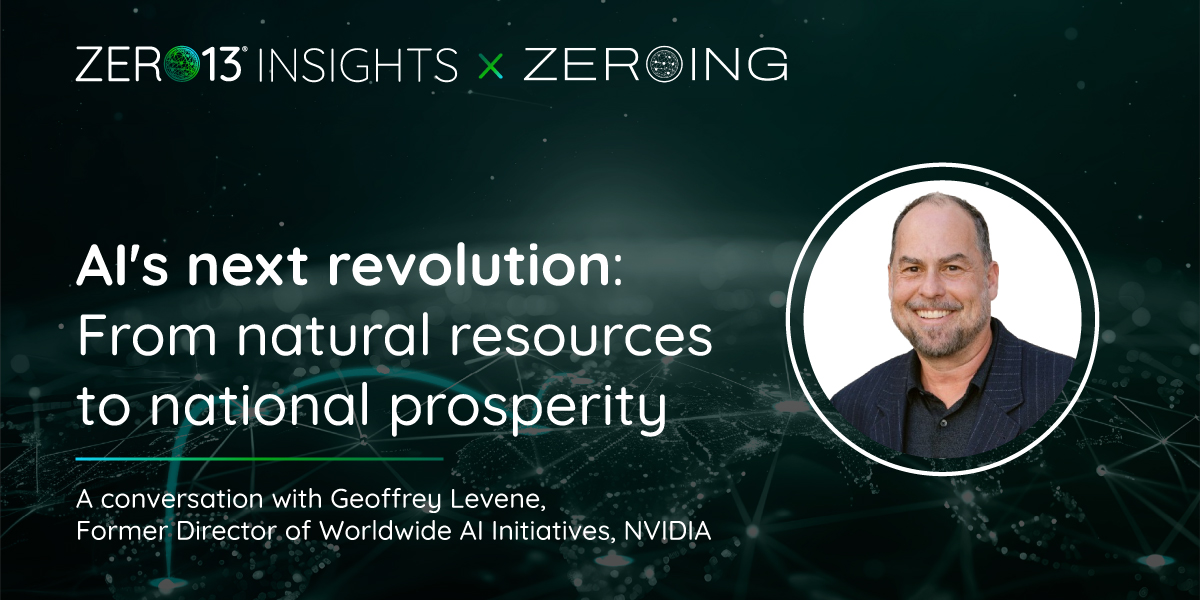
For Geoffrey Levene, former NVIDIA executive and the inaugural guest on ZERO13’s new ZEROING podcast series, the issue is not simply whether the world has enough resources. It is whether countries, companies and investors can coordinate their development effectively, and who ultimately benefits.
In a two-part conversation with ZEROING host and ZERO13 Founder and CEO Hirander Misra, Levene draws on his experience shaping NVIDIA’s global public-sector AI initiatives and his subsequent work developing AI infrastructure and investment opportunities internationally.
His central argument challenges much of the current AI investment narrative. “The bottleneck isn’t just one resource. The bottleneck is coordination.”
Beyond the chip: AI is an infrastructure economy
While investor attention has concentrated on GPUs, large language models and the companies developing them, Levene argues that these represent only part of a much larger economic ecosystem.
Energy generation, grid interconnection, digital connectivity, data centres, compute power and applications are interdependent. Beneath them sit the critical minerals, manufacturing capacity and physical resources without which the entire system cannot function.
A country may have abundant electricity but inadequate transmission infrastructure. It may have fibre connectivity but insufficient computing capacity, or access to capital without the skills, policies and development strategies necessary to turn investment into productive industries.
The implications extend far beyond technology companies. As demand for AI infrastructure accelerates, critical minerals, renewable energy resources and the infrastructure connecting them are becoming increasingly strategic economic assets.
This is also changing how investors assess opportunities. Rather than concentrating exclusively on the most visible AI businesses, Levene sees more sophisticated capital looking further upstream, identifying supply-chain constraints and infrastructure bottlenecks that could determine where future investment is directed.
From resource ownership to economic sovereignty
Historically, many resource-rich economies have exported raw commodities while processing, manufacturing and downstream industries have developed elsewhere.For countries rich in natural resources, particularly across the Global South, this creates a potentially transformative opportunity.
AI offers an opportunity to rethink that model, enabling countries with critical minerals, energy resources and available land to participate more directly in the infrastructure and industries those resources support. But doing so requires a different approach to national development, investment and policy.
Levene, who worked extensively with governments during his time at NVIDIA, makes an important distinction between commercial and sovereign priorities. Businesses typically evaluate investments against financial returns, costs and risk. Governments must also consider employment, education, infrastructure resilience, national security and long-term economic competitiveness.
His definition of sovereign AI captures the distinction: “Sovereign AI isn’t sovereign because the government owns every server. It’s sovereign because a country retains meaningful agency over its AI future.”
From Vietnam’s mineral resources to geothermal opportunities in East Africa, hydroelectric potential in Angola and emerging infrastructure investment across Latin America, Levene identifies significant opportunities beyond today’s established technology centres.
The common denominator is not simply resource abundance. It is the ability to turn those advantages into viable industries through the right combination of policy, infrastructure, investment and local capability.
Building infrastructure is not the same as building prosperity
Yet attracting investment and constructing infrastructure does not automatically translate into sustainable economic development. Levene questions whether conventional approaches to infrastructure investment deliver sufficient long-term benefits to the countries and communities hosting those projects.
Data centres, for example, can be built using imported expertise, operated by overseas businesses and dedicated primarily to serving customers in other markets. The physical infrastructure may be local, but its contribution to the host economy can remain limited.
For Levene, this risks perpetuating the historical imbalance between resource-rich developing economies and the countries that dominate global technology supply chains.
“We really want to bring prosperity into the countries that are the source of these minerals and the source of the energy and the source of the data centres of the future.”
This is particularly important in Africa, where a young population and substantial natural resources could provide the foundations for a different development trajectory.
AI itself could help accelerate that transformation, giving individuals greater access to education, technical knowledge and economic opportunities.
The objective should not simply be to extract more resources or install more computing capacity. It should be to build the skills and industries that enable communities to benefit directly from technological development.
The missing link: Manufacturing where resources originate
One of the most striking themes in the conversation is the disconnect between natural resource ownership and manufacturing capability.
Levene highlights the example of solar infrastructure in Africa, where countries with excellent solar potential can nevertheless face substantially higher deployment costs than other markets. Part of the problem lies in the global supply chain. Raw materials may be extracted in Africa, transported overseas for processing and manufacturing, then shipped back as finished products.
The countries supplying the resources consequently bear the cost of importing the technology needed to develop their own energy infrastructure. For Levene, advances in AI, materials science and additive manufacturing could begin to change this equation, making more distributed, locally based production economically viable.
Bringing processing and manufacturing closer to natural resources could reduce supply-chain dependencies, lower costs and support industrial development in markets that have historically relied on imports.
It could also create new investment opportunities across the wider AI infrastructure ecosystem, linking critical minerals, clean energy, manufacturing and digital infrastructure.
Turning natural resources into intelligence
Levene’s longer-term vision extends beyond physical manufacturing. He describes AI as a new form of industrial production in which energy and computing infrastructure are used to generate intelligence as an economic output.
For resource-rich countries, this creates an opportunity to consider how natural assets might support domestic computing capabilities rather than simply being exported to finance development elsewhere.
Importantly, Levene does not believe every country needs to build enormous AI factories.
“What’s the least amount of compute you can bring into a nation that can have the most change for a government and for its people?”
Smaller-scale inference infrastructure, locally relevant applications and investment in skills could provide a more practical starting point for countries seeking to establish their place in the AI economy.
Financing will be critical. Levene explores the potential for countries to leverage their mineral wealth and other natural resources to attract the capital and computing infrastructure required to develop new economic capabilities.
This is where the intersection of natural resources and global financial markets becomes particularly significant. ZERO13’s approach to sustainable real-world assets is built on a foundational ethos of connecting the entire value chain, from source to sale, enabling natural assets and associated economic activity to become more accessible, traceable and investable through digital financial infrastructure. Rather than treating commodities, energy, technology, capital and climate as separate markets, the opportunity is to connect them through a more transparent and sustainable investment ecosystem.
Exporting intelligence, not just commodities
Ultimately, Levene’s vision is about economic self-determination. Countries with the right combination of resources, policies, infrastructure and human capital could become producers of AI-enabled services, applications and intelligence, rather than remaining dependent on technology developed elsewhere.
As he puts it: “I’d like to have an abundance of intelligence, use the intelligence I need for myself, and then export the remainder of intelligence.”
Achieving that ambition will require governments to develop policies that attract investment and innovation, financial markets to create more effective ways of funding infrastructure, and technology companies to support the development of local capabilities. It will also require a broader definition of economic success, one that measures not only investment returns but also improvements in national competitiveness, employment, skills and economic resilience.
The next AI revolution presents an opportunity to fundamentally change the relationship between natural wealth and national prosperity. Realising that potential depends on connecting the entire supply chain, from critical minerals and energy to computing infrastructure, applications and ultimately, economic opportunity.
Listen to ZEROING with Geoffrey Levene
In the inaugural two-part episode of ZERO13’s new podcast series, Chairman and CEO Hirander Misra speaks with former NVIDIA executive Geoffrey Levene about the intersection of AI, critical minerals, energy, sovereign economic development and the opportunities to build a more inclusive global economy.
Part One: Connecting the AI economy: Critical minerals, energy, infrastructure and sovereign opportunity.
Listen here: https://audioboom.com/posts/8963693
Part Two: From natural resources to national prosperity: Local economic development, distributed manufacturing and the future of AI.
Listen here: https://audioboom.com/posts/8963698